Showing posts with label moving. Show all posts

Sep 22, 2009

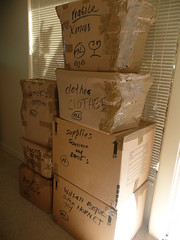
Moving: Filling up All the Boxes


Whereas last time we analyzed the hidden cost of moving, in today's article we are going to concentrate on the best way to pack before the actual move. Packing all the stuff before moving is something many people are afraid of. To be successful with this activity, you will need plenty of time, boxes, various wrapping material and a system in place. Without a sufficient plan, the move is bound to become an even worse nightmare than it necessarily is. Time Beginning the night before the actual move, even if you're only moving from a one bedroom apartment, isn't the best approach. In an ideal situation you'd want to be done one day before the day of moving so that you have enough time to pack all the forgotten things people always find in the last minute, food from the fridge and all the things you are using on a daily basis.

Boxes and packing material

Even though it's a useful idea to use all the suitcases and bags you already have at hand, that will hardly be enough. The most necessary packing material you will need are boxes, bubble wrap and newspaper (for securing kitchen ware). Additional supplies usually include permanent markers, packing tapes, polyfoam wraps, polystyrene beads, plastic bags and other various accessories.

With boxes, you may either buy them (they are usually between $1.50 to $5 per box) or you could ask at nearby stores for empty boxes, which could significantly decrease the cost of moving, if you manage to get enough of them. Also, most moving companies offer you the chance to buy or rent the boxes directly from them. As for the amount - of course that depends on the size of your home, number of rooms, number of family members and their routine of hoarding redundant things accumulated over a number of years. But the consensus is that for a standard 5-bedroom home you will need as much as 100 boxes. If that looks like too many for you, just imagine how many boxes will be necessary to pack all your stuff only from the kitchen and living room! No matter which way you acquire them, make sure you have a rich selection of sizes. Professional moving companies who offer the hiring option, will be happy to come and inspect your home and give you an estimate of the number of boxes necessary.

To find more secret tips, please follow the complete article Packing before moving.

Image: Can in a box by Tabbymom.

Aug 27, 2009

Relocating: The Hidden Cost


Relocating. This operation may get much more expensive than you would originally think, especially in case any problems come up (and sometimes even if they don't). No matter what way of moving you are considering, whether moving on your own or hiring professionals, there are always some expenses included. In this text we will break them down to give you a general idea what to be prepared for. Now you are maybe asking, so what's the problem then? Basically, there are two issues: in case of moving done by people themselves, it is too common to forget about all the additional tools, packaging material, transportation or the value of the time. But all these are related expenses you should count with. Also in case of moving with the help of a professional company, you might come across problems related to wrong company choice, wrong price calculation, or undervaluation of all kinds of additional expenses that are necessary, but weren't included in the company's bill. If you recall the first article of our "moving" series, we have already described the three options how to sort out your moving. They all differ by the level of your own involvement: either the professionals do everything for you, or you can manage all the work yourself - packing, loading, transporting and unloading. Or you may hire a company offering a hybrid service in case you’d like a bit more control over the whole process. Some companies might offer only the transportation; while other companies might offer loading, unloading and transportation of ready-packed things.

What’s involved? When you are beginning to organize your moving, the first step should be that you think about the budget. It will save you lots of trouble later. Generally, the relocation expenses can be broken down into four main categories: the transportation of your stuff, the packing of your stuff, the transportation of you and your family and the cost of starting up in your new home. The actual relocation. The first step should be calculating the main cost of moving your stuff. So will you be moving on your own, or hiring a company? This is the crucial issue you have most likely already decided. If a professional help is the way to go for you (we will bring some more tips on choosing the right company in one of the following articles), first contact them and ask for a written estimate of the price. It should say clearly whether the estimated price is binding or not, that means whether it is the final price, or there might be other fees coming up. Also the tips should be included - generally about $25 per worker.

The work and its cost. Secondly, the cost of the manpower that will do the packing and loading should be estimated - it may be the hired professionals, but also friends or family ready to help (it would be nice from you to at least buy them a dinner!), and also the cost of your time, especially if you need to take some off work. You should also count with the cost of any packaging material (boxes, bubble wrap, tapes etc.) and/or tools (i.e. dollies) you will need.

How much is the transport?. Thirdly, you have to estimate the price of the transport for you and your family - either flights, train or bus ride, or the price of petrol, if you are planning to travel by car. Also accommodation, food and possible entertainment while travelling should be calculated into the total price.

After the relocation: starting fresh There is usually a lot of problems and extra expenses connected to the moving, that people don't think about when they are in the middle of all the boxes. For example, you might have to pay a start-up fee for connecting up utilities such as a cable or telephone. Or think about your most likely empty fridge and freezer and the price of all the groceries to fill them up again. Also think about the price of any items you have left behind and you need to replace them now, such as various household items. Or maybe your new house needs a fresh coat of paint. It is always helpful to think first and jot down the costs of all the necessary items to buy, so that the total sum doesn't shock you after the moving.

As a Vancouver real estate agent, I have always tried to help my clients even with this issue, therefore I would like to share with you some useful tips & tricks: 1) Always compare how much it would cost you to move a certain item against how much the item costs when bought new. The result of this comparison might shock you. 2) You might have a chance to get a moving package from your new employer, if you are moving because of a new job. 3) Keep all the receipts connected to moving since you might be eligible for a tax deduction.

Photo: by Linda Yvonne

Aug 13, 2009

Moving: With Professional vs. Friends and Family


Moving your stuff from one place to another has never been simple, but as an experienced Vancouver realtor, I have gained valuable knowledge on how to deal with this complicate issue. However, just as in any similar case, experienced people can help you with some advice that will make this task easier. In order to help you, we will publish a series of texts about all the various aspects of a relocation: how much it costs, how the insurance works, how to choose the right company, and much more.

The first article will help you to decide whether to hire a professional company or do it yourself. Among the most important issues are the amount of money, time and labor you have available from your own resources.

Definitely the best thing to start with before deciding which approach you choose, is to write down and estimate the amount of things you will be moving and then asking yourself the following questions:

- How long will it take you to pack everything?
- Can you manage the furniture?
- Have you any special, expensive or heavy items that need special handling, such as pianos or the collection of art?
- Do you have any friends or family members living nearby, who could come and help you during the weekend?
- For the moving, you will need a large car - do you trust yourself driving something like that?
- Will you manage to accomplish your move over the weekend or will you have to take some days off work?

First you need to ask yourself all these questions, and depending on the results you have got, you will be able to pick the best way of moving.

In general, there are three options:

1. Full-service movers

There are a lot of companies specializing in helping clients to move, including packing the things, loading onto the vehicle, driving it to the new place, unloading and unpacking it. Well, however costly this may be, it's the best method for people who have nobody to help them, or who just don't have enough time to do the job themselves. All the packaging material, straps and all the necessary equipment is provided as a part of the service. All that is left to you is to let them do the job.

2. Self-service movers

If you decide to go for this method, you will be expected to be more involved too. The level of service provided may be not the same in each company. On one side of the scale, we have some companies that only provide a car with a driver, and the rest of the work (packing, loading & unloading etc.) is up to you to do or organize. On the other hand, the service may include help with loading & unloading, which you will appreciate especially in regard to the heavy furniture. This method of moving is the best one for the people who want to have more control over the whole process. And of course it is much cheaper than the full-service.

3. Do-It-Yourself

If you are able to do the whole moving by yourself, you will save a lot of money. Before choosing this method, there are many aspects to be considered, like the amount of your possessions, the distance, the number of friends and relatives available to help you and other things. The do-it-yourself way is usually great if you are moving from a small home or a flat. On the other hand, when moving from a large home across a long distance, it is usually better to use some professional help. However you want to organize your moving, a crucial part of the planning is the budget. Therefore the next article will deal with the cost that’s involved with moving.

Picture: Credits to carlaarena