Showing posts with label new house. Show all posts

Oct 15, 2009

Are You Considering a Solid Investment? Why Don't You Think about Bricks and Mortar?


As an answer to the most recent recession in the housing market in Canada, REMAX Canada released a report analyzing the local Canadian housing markets over the last 30 years. Over this period of time the report concludes that investment in bricks and mortar has always been one of the principal and securest option.

The market for residential housing throughout Canada still shocked economists and housing analysts according to the report. There have been three great slumps in the Canadian housing market over the last 30 years, two of them were in the 1980's and the most recent in 2008. In comparison to the 1981 and 1989 market downturns the downturn in 2008 was the quickest with sales and prices quickly flourishing again. Buyers have lost their market, which has now pivoted into leveraged or even a sellers' market.

Long term soundness of real estate investments is based on various factors in Canadians established belief in houses and condos. Real estate exhibits fiscal and material "fortresses" for most Canadian investors. Over the last three decades there has been a significant rise in the purchase of houses of over 6%. With a 12% rise, Calgary has seen an even larger increase in property purchase.

Regardless of the above communicated downturns and smaller variations, real estate remained a very well appreciating investment, with Vancouver, Victoria and Toronto as rulers in terms of price appreciation. This years greatest increase in the real estate market comes from the Greater Vancouver area with a massive 14% increase. The major buyers are depicted by first-entry purchasers, however the over $1 million segment is also being galvanized by trade-up buyers.

Vancouver is classified the greatest performing market in the whole of Canada for housing price increases.

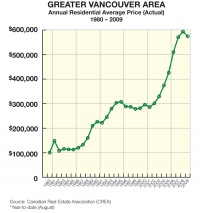
In Vancouver real estate prices have grown nearly 500% in comparison to just over 350% for the rest of Canada since 1980. There has been a 10% increase in house ownership since 1981. Just compare this with inflation for the corresponding period. Over the same period there was a 156.6% increase in inflation looking at the Bank of Canada calculator. In other words: investing $100,000 into real estate 30 years ago would bring you almost $320,000 net return.

This information is not news to nearly all Canadians. Real estate rather than stock investment is the favorite choice of 77% of Canadians according to the September survey administered by The Angus Reid Omnibus.

Aug 13, 2009

Moving: With Professional vs. Friends and Family


Moving your stuff from one place to another has never been simple, but as an experienced Vancouver realtor, I have gained valuable knowledge on how to deal with this complicate issue. However, just as in any similar case, experienced people can help you with some advice that will make this task easier. In order to help you, we will publish a series of texts about all the various aspects of a relocation: how much it costs, how the insurance works, how to choose the right company, and much more.

The first article will help you to decide whether to hire a professional company or do it yourself. Among the most important issues are the amount of money, time and labor you have available from your own resources.

Definitely the best thing to start with before deciding which approach you choose, is to write down and estimate the amount of things you will be moving and then asking yourself the following questions:

- How long will it take you to pack everything?
- Can you manage the furniture?
- Have you any special, expensive or heavy items that need special handling, such as pianos or the collection of art?
- Do you have any friends or family members living nearby, who could come and help you during the weekend?
- For the moving, you will need a large car - do you trust yourself driving something like that?
- Will you manage to accomplish your move over the weekend or will you have to take some days off work?

First you need to ask yourself all these questions, and depending on the results you have got, you will be able to pick the best way of moving.

In general, there are three options:

1. Full-service movers

There are a lot of companies specializing in helping clients to move, including packing the things, loading onto the vehicle, driving it to the new place, unloading and unpacking it. Well, however costly this may be, it's the best method for people who have nobody to help them, or who just don't have enough time to do the job themselves. All the packaging material, straps and all the necessary equipment is provided as a part of the service. All that is left to you is to let them do the job.

2. Self-service movers

If you decide to go for this method, you will be expected to be more involved too. The level of service provided may be not the same in each company. On one side of the scale, we have some companies that only provide a car with a driver, and the rest of the work (packing, loading & unloading etc.) is up to you to do or organize. On the other hand, the service may include help with loading & unloading, which you will appreciate especially in regard to the heavy furniture. This method of moving is the best one for the people who want to have more control over the whole process. And of course it is much cheaper than the full-service.

3. Do-It-Yourself

If you are able to do the whole moving by yourself, you will save a lot of money. Before choosing this method, there are many aspects to be considered, like the amount of your possessions, the distance, the number of friends and relatives available to help you and other things. The do-it-yourself way is usually great if you are moving from a small home or a flat. On the other hand, when moving from a large home across a long distance, it is usually better to use some professional help. However you want to organize your moving, a crucial part of the planning is the budget. Therefore the next article will deal with the cost that’s involved with moving.

Picture: Credits to carlaarena