Showing posts with label property. Show all posts

Nov 5, 2009

Thinking about Renting out a Fully Furnished Apartment? Think Twice, It Is Not That Easy


Are you an owner of a small flat or a condo? It may be a perfect idea to rent it out as a fully furnished place. People who usually rent such places mostly need a home ready to be moved into, without the need to purchase anything - depending on their lifestyle. But before you will get any extra cash from renting your fully furnished property, first you will have to make a lot of decisions and think about many details.

How much will it cost you?

Preparing your place and setting everything up will certainly cost you something, and finding out how much is the first step. Examine the listings of other fully furnished properties available in your area. Try to find some properties that are close to yours - in size, location and furnishing. Once you have a pretty good idea of the rent that is commonly charged for a fully furnished place such as yours, list everything that you would have to purchase in order to fall into the category of 'fully furnished'. Not only all furniture, but also utilities such as gas, electricity, water, phone, cable, wireless Internet or security services, and all kitchen ware, plus towels, bed linen and cleaning supplies - all of this is expected from you to take care of nowadays, if you are renting out your flat as fully furnished.

The next step is to make up your mind if you can afford to fully furnish your apartment to the extent described above. Make a list of all the things you will have to purchase so that your place is fully furnished. Also think about the fact that there may be multiple tenants over a number of years, with times of unoccupation between them. If you decide that making your flat fully furnished would be too difficult for you now, there is a possibility to list it as "part-furnished". That would mean a bit less attractive possibility than fully furnished, but at the same time less hassle and an easier life for you.

List all the equipment, set up a deposit

In case you have lived in the flat for some time, start with removing all your personal private things, such as photographs. The next thing to do is to prepare an inventory of all items in the flat. You should go through the inventory together with the tenant, walking through the flat and seeing everything provided by you together. That should include counting individual items such as the amount of spoons, forks, knives towels or linen. As part of good practice, there should also be your rental agent present when doing the inventory, and then when all sides agree on the list, they sign it. When the contract expires, it is time to go through the flat with the list again, noting down all facilities. Anything that has been damaged or lost will have to be replaced and paid for from the deposit which was agreed at the start of the contract.

Now with the winter Olympic games coming soon, the opportunity of renting out a fully furnished place seems like a gold mine for more and more people in Vancouver. But if you don't already own a suitable unit and would have to start from scratch, the whole idea might turn into a nightmare. The return on investment for rental properties should be planned over the long term and not just seen as a 'get-rich-quick' plan.

Oct 15, 2009

Are You Considering a Solid Investment? Why Don't You Think about Bricks and Mortar?


As an answer to the most recent recession in the housing market in Canada, REMAX Canada released a report analyzing the local Canadian housing markets over the last 30 years. Over this period of time the report concludes that investment in bricks and mortar has always been one of the principal and securest option.

The market for residential housing throughout Canada still shocked economists and housing analysts according to the report. There have been three great slumps in the Canadian housing market over the last 30 years, two of them were in the 1980's and the most recent in 2008. In comparison to the 1981 and 1989 market downturns the downturn in 2008 was the quickest with sales and prices quickly flourishing again. Buyers have lost their market, which has now pivoted into leveraged or even a sellers' market.

Long term soundness of real estate investments is based on various factors in Canadians established belief in houses and condos. Real estate exhibits fiscal and material "fortresses" for most Canadian investors. Over the last three decades there has been a significant rise in the purchase of houses of over 6%. With a 12% rise, Calgary has seen an even larger increase in property purchase.

Regardless of the above communicated downturns and smaller variations, real estate remained a very well appreciating investment, with Vancouver, Victoria and Toronto as rulers in terms of price appreciation. This years greatest increase in the real estate market comes from the Greater Vancouver area with a massive 14% increase. The major buyers are depicted by first-entry purchasers, however the over $1 million segment is also being galvanized by trade-up buyers.

Vancouver is classified the greatest performing market in the whole of Canada for housing price increases.

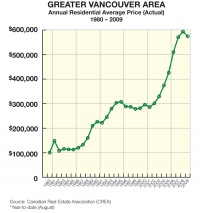
In Vancouver real estate prices have grown nearly 500% in comparison to just over 350% for the rest of Canada since 1980. There has been a 10% increase in house ownership since 1981. Just compare this with inflation for the corresponding period. Over the same period there was a 156.6% increase in inflation looking at the Bank of Canada calculator. In other words: investing $100,000 into real estate 30 years ago would bring you almost $320,000 net return.

This information is not news to nearly all Canadians. Real estate rather than stock investment is the favorite choice of 77% of Canadians according to the September survey administered by The Angus Reid Omnibus.

Aug 29, 2009

Generation X: just about to outbuy baby boomers?


The recent RE/MAX report shows that the present Canadian market with recreational property has been taken over by Generation X, which replaced the previous main buying force formed by the baby boomer generation growing older.

Who are the people in Generation X?

Over the years, social scientists have developed the practice of giving fancy names to the generations of the 20th century. Dating of a particular generation depends on all the different political and cultural features of the time that influenced the upbringing of members of that generation. The baby boom generation, that are people born from mid 40's till late 50's, was the strongest buying force, or at least until only a couple of years ago. But now the majority of these people have retired or are preparing for it.

Now the children of baby boomers (known as Generation X) have grown up and in their 30 - 40's they are in a sufficient financial condition to purchase recreational property at almost any price.
You will see this change especially when we compare the results of the first half of this year with the ones from last year. The trend moving toward recreational property buyers in their 30's was observed by 74 percent of markets in this year's surveys. The recreational properties sold varied from waterfront cottages to resort condos. This compares with only 40 percent in 2008. From January till April 2009, the number of sold recreational properties declined - at least two thirds of all surveyed markets reported such trend. But now, the buyer activity has grown with the beginning of the new cottage season, as we can see from the results of many major centres.

The most important points of the report:

Supply is suitable in most markets, but heated activity in the lower-end has resulted in tight inventory levels for entry-level product in 18 per cent of markets. Older cottage owners, a lot of whom own their properties outright, are selling to younger buyers with families. Some American cottage owners in Canada are taking advantage of the stronger dollar to cash out of the market. There are some exceptions of course, but we can say that American purchasers have mostly disappeared. One of the known factors in the marketplace is pent-up demand. For instance some buyers who had intended to purchase recreational properties in the second half of 2008 decided to defer the transaction till the next year. Florida, Arizona, California, Nevada and other warmer parts of USA are the states where older Canadians still continue to demand secondary homes. Generation X buyers are ready to spend their hard-earned money on vacation homes, but at the end of the day, they want to know that they’ve negotiated the best deal possible.

Photo source: thinkpanama